
The AI coworker that lives in your Slack.
Your team already decides things in Slack, and then somebody has to go and record them somewhere else. Via closes that gap. It turns a reaction into work that has an owner, answers questions about the week's leads and payments straight from the ledger, and writes every one of those moves back to the CRM and the dashboard the rest of the company reads.
Free plan forever with no credit card, and unlimited seats on every plan.
Viably runs from the dashboard on its own too, so Slack is what you gain rather than what you pay to enter.
@Via summarize this thread and file anything blocking the launch

3 blockers surfaced across 42 messages — filed the two that block launch.
- Issue #221 — annual-plan 500 (blocker)
- Issue #222 — webhook retry storm (blocker)
Three ways to set something in motion.
A reaction, a mention, or a command, and nothing to learn for any of them. Via watches for the reactions people send anyway, answers when it is spoken to, and turns either into a record that outlives the thread it came from.
Reactions
One reaction, one outcome, in the channel where somebody reacted.- 🏅 award a medal🐛 file an issue📌 pin it📋 make it a task⏰ remind us🔒 lock the thread🗓️ put it on the calendar📧 forward it on📷 scan the image
Mentions
Via reads the channels it was invited to, and nothing else.- File several issues from one threadCreate and reassign tasksFind an hour everybody is freeReport on the week's leads and paymentsUpload the matching rows as a CSV
Commands
For the jobs that have no message to react to.- /calendar/github-notify/leaderboard/tags
Your team already sends these. Via makes each one do something.
No syntax to learn, no form to fill in. The reactions people already use become work, records, and follow-ups in the channel where the decision was made.
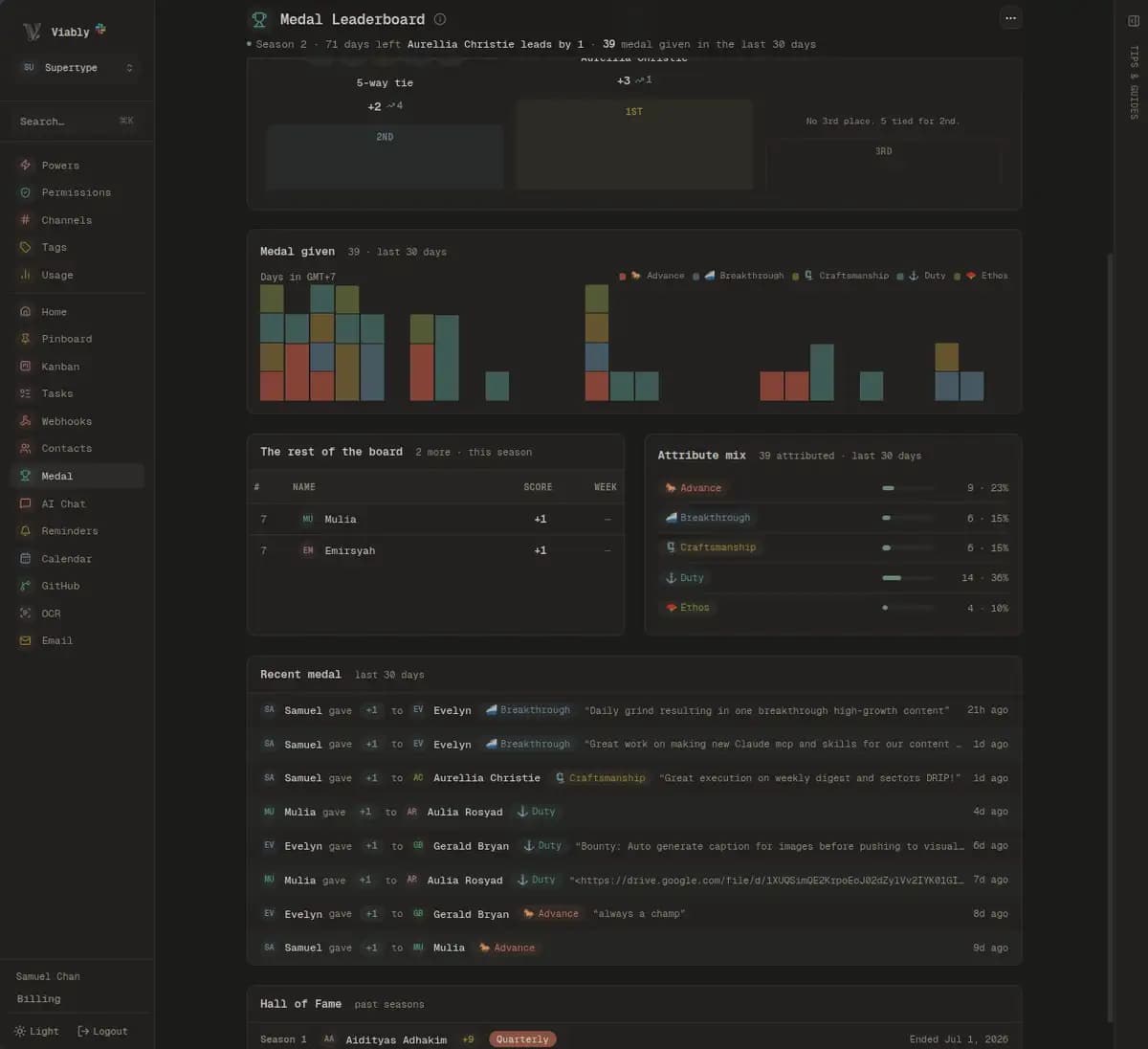
React 🏅on a teammate's message and Viably awards them a medal, then updates the leaderboard.
Shipped the checkout hotfix — annual plans are paying again ✅
Climbing the #product leaderboard.
 Viably
Medal leaderboard
Capture the lead, answer the question, and keep the promise.
These are the three things a revenue team does in Slack every week, and the three places the work usually leaks. Each play below is the conversation as it happens, beside the records it left behind once it was over.
Twelve seats, annual, asking about the migration window.
- Name
- Michael Scott
- Company
- Dunder Mifflin, Scranton
- [email protected]
- Source
- viably.app/pricing
Mine. Quoting them this afternoon.
- Task
- Send Michael the twelve-seat quote
- Owner
- @jim
- Due
- Today
- Follow-up
- 11:00, on the due date
The enquiry arrives on its own, and somebody owns it before the day is out.
- One ledger row
The enquiry kept with the payload that proves it, filterable by category months later.
- One contact record
Matched on the email address, so the payment that follows lands on the same person.
- One owned task
With a name against it and a follow-up already scheduled for the day it is due.
Say what you want in a sentence, and let it be several things.
A request in a channel is rarely one instruction. It is a task, a bug, and a promise to check back on Friday, all in the same breath. Via reads the whole message, works out which of its tools each part needs, and carries them out together, so the reply in the thread is a list of things that already exist rather than a suggestion about what you could do next.
Read the guideDone — created 3 items:
- Draft launch checklist
- File bug: annual plan 500
- Remind #eng on Friday 4pm
An assistant an admin can audit.
Every turn is recorded with the model that answered it, what set it off, how long it took, and what it cost, so the AI line on the bill is a page somebody can open.
Several actions from one sentence
Ask for the quote to be tracked, the bug filed, and the channel reminded on Friday, and Via carries out all three from the message you already wrote.
Two-tier model routing
A fast model reads what you meant and a capable one runs the tools, which keeps the actions accurate without leaving the channel waiting on a long think.
Eight models, one picker
Pick the model your workspace prefers from the command center, or bring your own provider key and pay for the usage at cost.
Answers drawn from your own ledger
Questions about leads, sign-ups, contact forms and payments are answered from the relay ledger over any date range, and Via will upload the matching rows as a CSV.
Only the channels you invite it to
Via reads the channels it has been added to. Private channels and direct messages it was never invited to stay closed to it.
Every turn metered and visible
Model, trigger, latency and cost are recorded for each call, so an admin reads a number rather than discovering one.
It chases the work it created, and files the receipt itself.
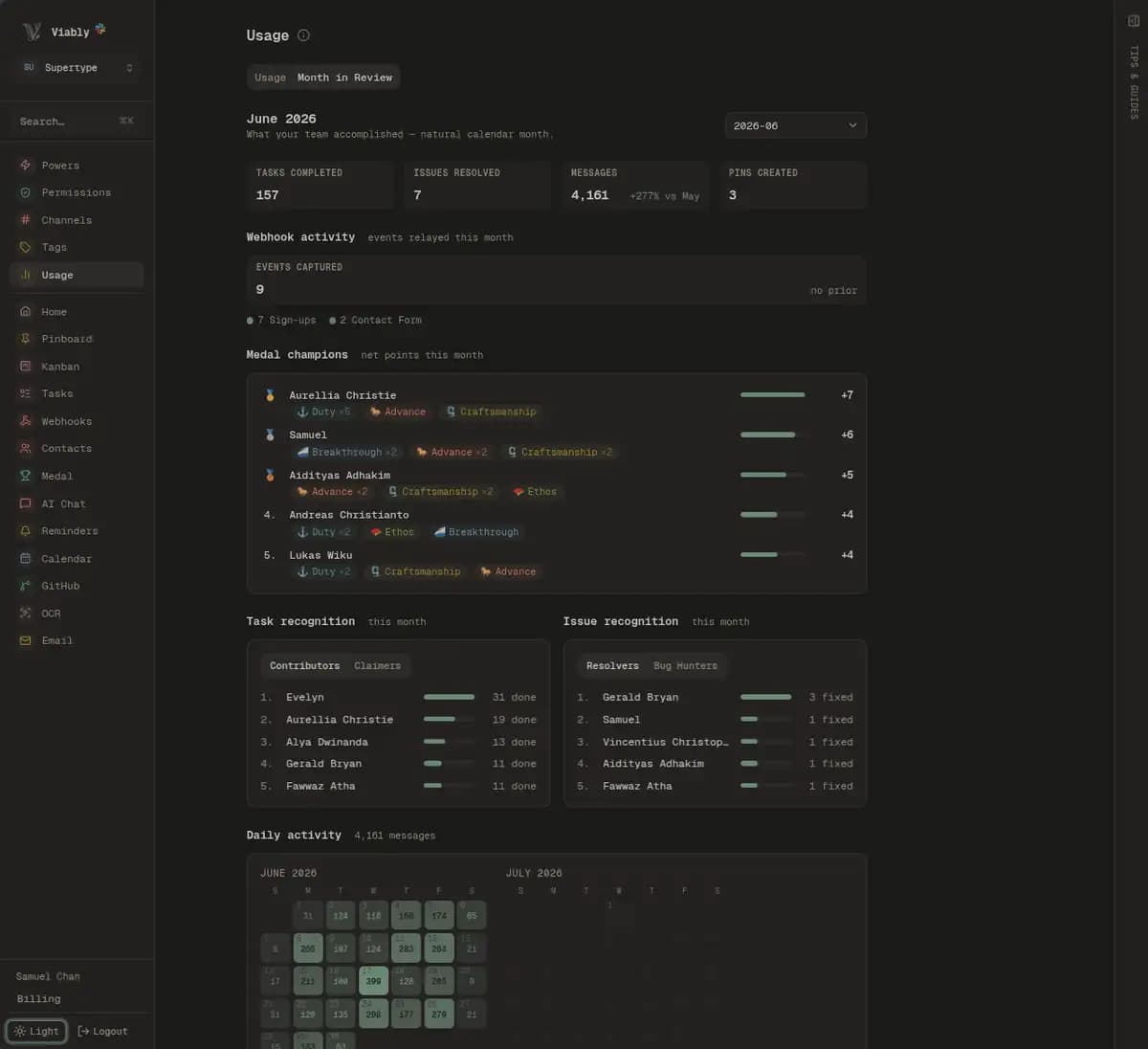
Creating a task is the easy half. Via checks in at 11:00 on the day it is due, nudges the owner privately when it slips, gives the person who asked a quiet heads-up, and writes the completion back to the ledger, so the month adds up without anyone assembling it.
1,284events onthe record
Say when the way you would say it out loud.
React with the alarm clock on the message you do not want to forget and answer in plain language, or ask Via to nudge a whole channel. The phrase you wrote is resolved to an exact weekday, date and wall-clock time in your workspace timezone by a parser rather than guessed at by a model, which is why the time it schedules is the time you meant.
Let's revisit the pricing rollout after launch week
Reply with a time — I'll keep this thread attached.
in 2 weeks
I'll nudge you here with a link back to this message.
React ⏰ on any message and Via asks when. Reply in plain language and it's scheduled — the original message comes along as context, so the nudge always lands with a link home.
Wednesday, 18 Jun · 4:00 PM
+3 daysin your workspace timezone (Asia/Singapore)
Relative or absolute, sloppy or precise — Via reads it the way you wrote it and pins it to an exact moment, in your team's timezone.
Reminder set
Friday · 3:00 PM · the retro
Set in Slack — and quietly written to the shared team calendar at the same time.
Everything Via does is auditable on a page you can open.
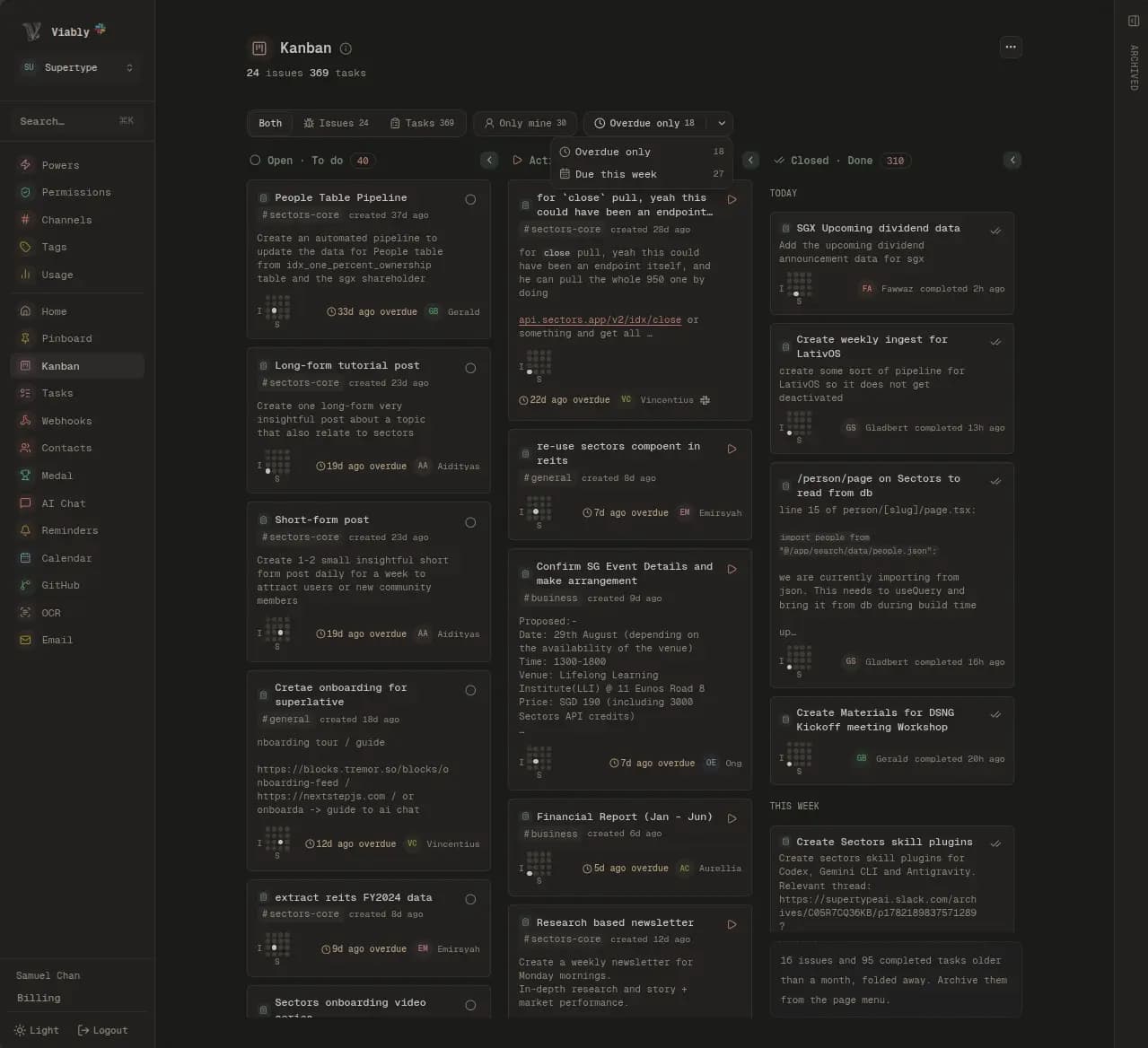
The dashboard is where an admin picks the model, reads what the assistant has been asked to do, and watches the tasks, reminders and medals it created pile up. The screens below are the ones Via fills on its own.
ViablyEvery issue, every task on the kanban, and everything that moves the needle for our team goes through Via. It organizes work in a way that is truly only possible because of all the automation hooks that it packs with it. We cannot imagine having to work without it after the third month.
 Gerald BryanLead Architect, Sectors Financial AI Suitesectors.app
How this sits beside the tools you are probably paying for.
Most Slack teams already have a builder wiring events into a channel and a point tool or two doing one job each. These are the honest comparisons, capability by capability, including the cases where the other tool is the better pick.
Bring the whole workspace. The price does not move.
Viably is billed per workspace rather than per seat, so inviting support, sales and engineering into the same channels costs nothing extra. The Free plan carries the full feature set including Via, and Viably+ raises the limits for teams whose event volume has outgrown it.
Questions about the Slack integration
Connect something else
Everything lands in the same record, so the second service you connect takes less setting up than the first.
Put Via in the channel where the work already happens.
Add Viably free, invite Via to one channel, and watch the first reaction become something somebody owns.
- Free to start
- No credit card required
- Powers on when you need them