
Your Google Search Console data, turned into work somebody owns.
Reporting is the easy half of search, and every team already has more of it than they read. Viably works the same data every day, finds the pages and phrases that are quietly costing you clicks, and puts each one in front of your team as something to do, with the fix named and the traffic it is worth written beside it.
Free plan forever with no credit card, and unlimited seats on every plan.
One property free, three on Viably+, and a Restricted grant in Google is the whole setup.

Posted with the weekly pulse, in the channel that already receives it.
- Clicks
- 6,240 (up 12%)
- Average position
- 9.1, from 10.4
- Worth doing
- 3 findings, 1 to act on
Sixteen months of history, then every morning after.
The first sync walks back through everything Google still holds on the property, which takes a few minutes. The sweep that follows runs before your team is awake.
Performance, daily
Held per property, per query and per page, keeping the 250 that carry the traffic for each day.- ClicksImpressionsClick-through rateAverage position
Inspected, page by page
Google's own coverage report has no API, so Viably rebuilds it one inspection at a time and remembers what it said last week.- Index verdictCrawl stateThe canonical Google pickedWhen it last looked
Worth doing
Graded by what each is worth as a share of that property's own traffic, so act, look and note mean the same thing on a four-hundred-page site as on a forty-thousand-page one.- Query shortfallStriking distancePages that stopped being servedWatchlist slips
Every site is sitting on traffic it earned and never collected.
A query taking twenty thousand impressions at position six and converting a handful of them will never appear on a top-queries list, because that list is sorted by the exact number that is too low. Viably folds the near-duplicate phrases into one row, compares each one against what its rank usually earns, and orders what is left by the clicks the shortfall is worth. Opening a row divides it by intent, which turns a keyword list into a content brief.
Every panel here answers a question your team gave up asking.
Search Console hands you a search box and a list of everything, which is why most teams open it once something has already gone wrong. Viably sweeps the same data before your team is awake and does the work nobody has the afternoon for, folding the near-duplicate phrases together, measuring each one against the click-through its rank ought to earn, inspecting the pages that carry real impressions, and remembering what Google said about them last week so this week's answer means something.
What comes out is a short page of panels, and every one of them settles a question that got quietly dropped somewhere around the second quarter: which phrases people see and scroll past, what is sitting on page two close enough to be worth an afternoon, which pages Google has stopped serving and how many clicks left with them, and which of your landing pages have produced paying customers rather than merely traffic.
A finding that stays a finding was never worth generating.
SEO work dies in the gap between noticing something and somebody owning it. Viably closes that gap inside the inbox your team already triages: the finding arrives with the endings its own kind is asking for, one click files it where the work actually lives, and the card leaves the list because the thing it was asking for has happened.
 Viably
- It becomes an issue on the board
The evidence, diagnosis and affected pages go with it. If a repository is connected, the issue is mirrored to GitHub with everything the developer needs.
- Or a task with a date and an owner
Content work needs an owner and a deadline. The task lands on the board with both, posts a card in your channel and reminds the owner when it's due.
- Snoozing waits on the clicks
Snooze an item and Viably brings it back once the clicks behind it grow by half, when there's something new to decide.
- Dismiss it once, for good
Noindex tags, redirects and canonicals all look like pages leaving the index. Dismiss the group once with a reason, and new pages that join it stay quiet.
Every issue, every task on the kanban, and everything that moves the needle for our team goes through Via. It organizes work in a way that is truly only possible because of all the automation hooks that it packs with it. We cannot imagine having to work without it after the third month.
 Gerald BryanLead Architect, Sectors Financial AI Suitesectors.app
The people who need to know are not the people who log in.
Search problems have a habit of going unnoticed for a fortnight, and a dashboard only helps the person who opens it. Viably watches for three things worth interrupting somebody about and stays quiet the rest of the time, which is the only reason the interruptions still work six months in.
- Traffic really moved
Viably compares each day with the same weekday over the past four weeks and alerts you when it falls well below the usual.
- A page you watch slipped
Star a page or a query and you'll hear about it the day it drops off the first page of results, even when total traffic looks fine.
- The connection broke
If someone removes Viably's access or a property stops returning data, Viably posts a single message to your channel.
- The week, read back to you
Search performance joins the weekly pulse in whichever channel already gets it, with buttons that break the week down day by day.
Measured against the same weekday over the last four weeks, on settled data only.
- Clicks
- 612
- Typical Tuesday
- 928
- Days excluded
- 2, still restating
It fell off the first page of results overnight, so it is worth a look before the week is out.
- Page
- /guides/webhook-relay
- Position
- 8.2 to 14.6
The search that started the relationship, beside the money it ended in.
Search brings somebody to a landing page, and Viably already holds what happened next, because the form they filled in, the enquiry they sent and the payment they made were all captured against one contact record. Putting Search Console in the same system is what makes a search term stop being a vanity metric.
Viably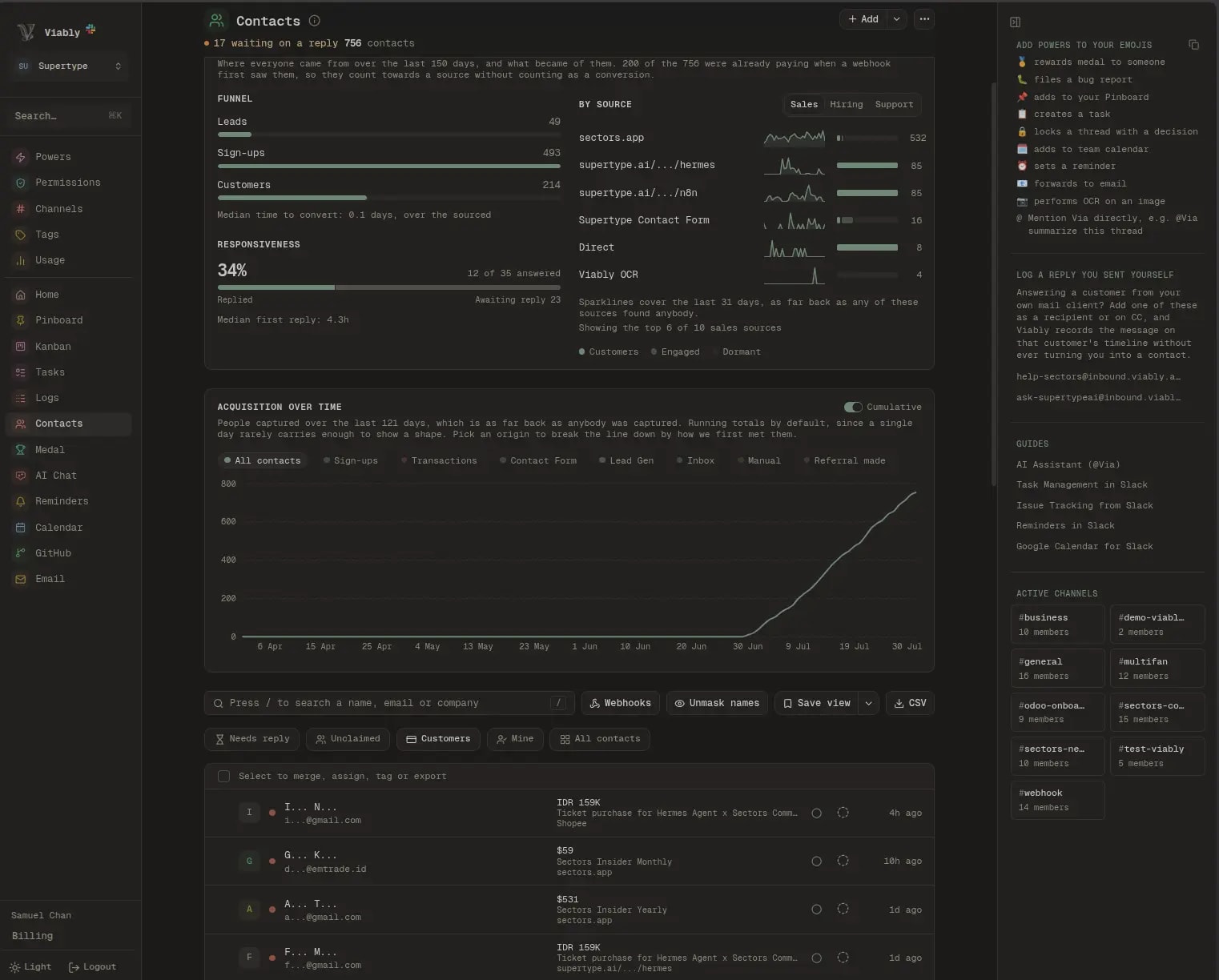
- Pages linked to the customers they won
Every contact keeps the source that first brought them in, along with their forms, emails and payments. Each customer traces back to the page that earned them.
- Revenue by page, beside the clicks
The Search Console dashboard has a revenue panel built from your actual payments, showing which content pays for itself.
- Ask about it where your team already is
Once a property is connected, anyone can ask Via about search performance in any channel. Answers come from your synced numbers with the period stated.
Priced per workspace, so the whole team can read the numbers.
Every other tool in this category charges by the seat, which is how SEO ends up being one person's job and everybody else's blind spot. Viably is billed per workspace with unlimited seats, the free plan carries a full property, and Viably+ raises that to three alongside everything else the workspace runs.
Questions about the Google Search Console integration
What does Viably do that Google Search Console does not?
Does this replace Ahrefs or Semrush?
How is this different from a Looker Studio dashboard?
Can it open a GitHub issue for an SEO problem?
How does Viably decide what to show first?
Will this flood our Slack channel?
How many websites can we connect, and what does it cost?
Is my Search Console data safe?
How long before it finds something?
Where this leads next
Audience and search
What people searched for to find you, and what they did with the posts you published.
Stop reading the report. Start working the list.
Add Viably's address to your property in Google, and sixteen months of history plus the first findings are waiting by the time you get back.
- Free to start
- No credit card required
- Powers on when you need them