
The Viably philosophy
Five principles decide what goes into Viably and, more often, what stays out of it. They are the same ones our own companies run on every day, written down here so you can tell early on whether your team would recognise itself in them.
Founder efficiency
We built Viably for lean teams that care about how their people convert time into high-leverage activities. To achieve this, Viably defaults to automation and elimination of low-value work. Instead of building tools that help teams manage work, we seek to eliminate low-value work entirely by gluing processes together around a single source of truth and cutting any operational drag that sits between a team and their customers.
Teams using Viably should be able to report much faster decision-making, higher throughput, and better customer engagement loops rather than getting bogged down in a neverending cycle of multitasking between tools.
At Supertype, our founding team ruthlessly delegates non-core work to Viably, and we expect the same of our customers. Consider how we designed the one-address feature. You tag Via by email in the same way you would tag a coworker in an email, or Google Calendar or Slack, and Viably automatically files the interaction on the correct customer record. It's efficiency by default, and works silently in the background so your team has the latest information on Viably's CRM without even thinking about it.
 1,284events on
the record
On your Usage panel and in the Month-in-review, you can see how much time Viably has saved your team; it is a metric we track internally as well, and we are constantly looking for ways to improve it. We want to help our customers achieve the same level of efficiency that we have achieved internally at Supertype, and every design decision is guided by efficiency-gains questions.
Viably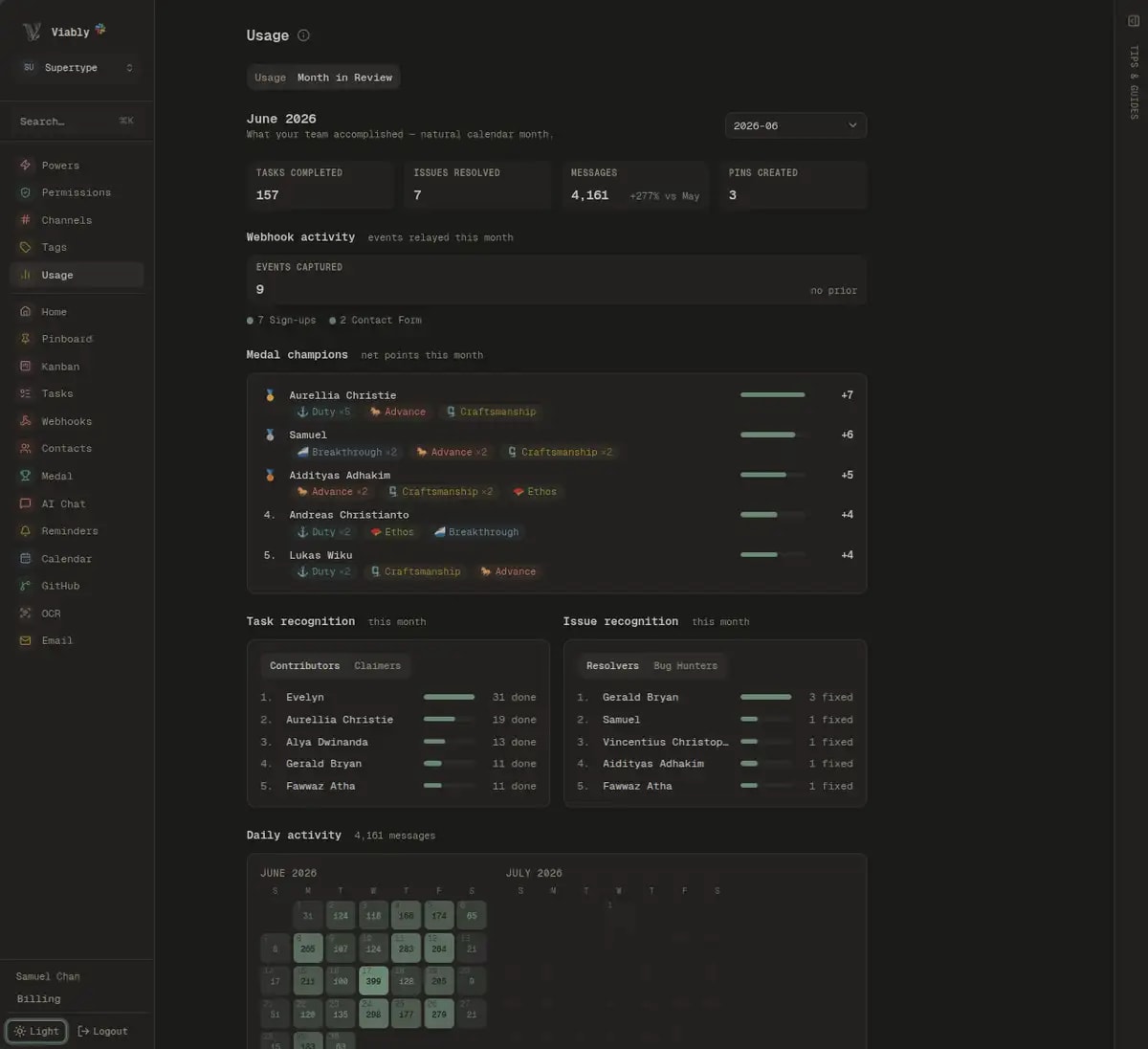
Single source of truth
Another tenet of the Viably philosophy is a centralized ledger of events and interactions that form the backbone of all records, tasks, issues, and decisions. You can use Viably's extensive support for webhooks, email, Slack, and other integrations (like our native support for Google Search Console and Stripe) to automatically capture events into a single source of truth that moves the right automation levers and keeps your team aligned.
Consider our automation-first CRM. When a customer sends an email to your team, Viably automatically files it on the correct customer record, and any replies your team sends are also filed on the same record. If a customer books a meeting with your team, Viably automatically files it on the correct record as well. Any in-app events, Stripe transactions, and other client-facing events are all timestamped and added to the customer's lifecycle record by Viably. Client success teams, account managers and technical support all have one place to see the full history of a customer, regardless of contact-points that they have used to communicate with your team.
Viably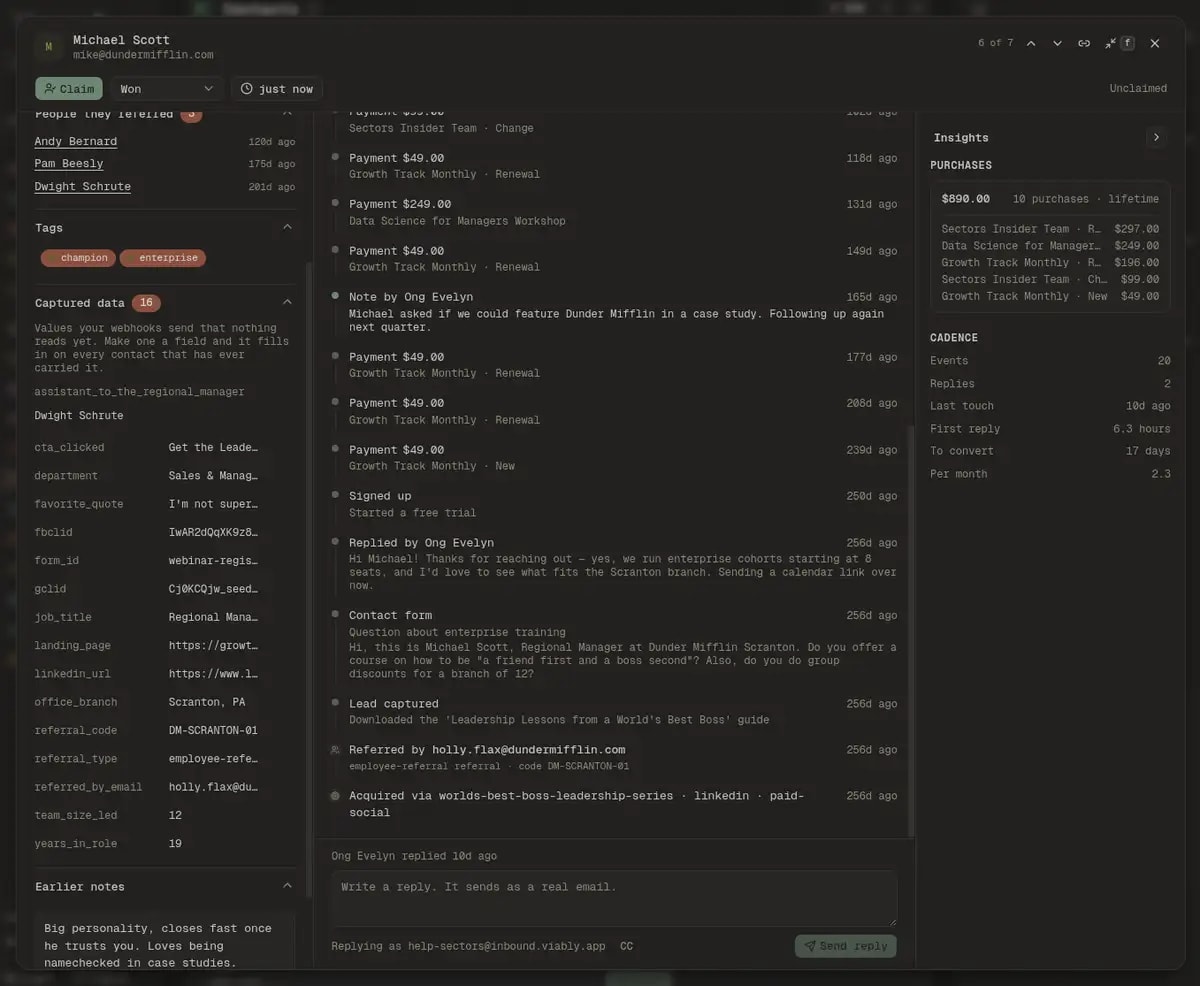
Don't overreact. Don't underreact.
The view Viably welcomes you with is a highly calibrated Inboxthat shows you the most pressing items that require your attention, those it chose to escalate to you based on your team's priorities and the customer's lifecycle stage, and recommendations Viably makes but want your review on before taking action.
In our opinion, this strikes the right balance between autonomous AI work and human oversight. We build Viably to be an observability layer, which means it has the potential to capture too much and overwhelm your team with low-value signals and notifications. The don't-overreact-don't-underreact principle serves as the counterweight to this risk, because Viably separates the signal from the noise by the time it arrives in the Inbox view, with concrete actions and recommendations based on what it reads off the consolidated customer record and external systems like Google Search Console and Stripe.
Viably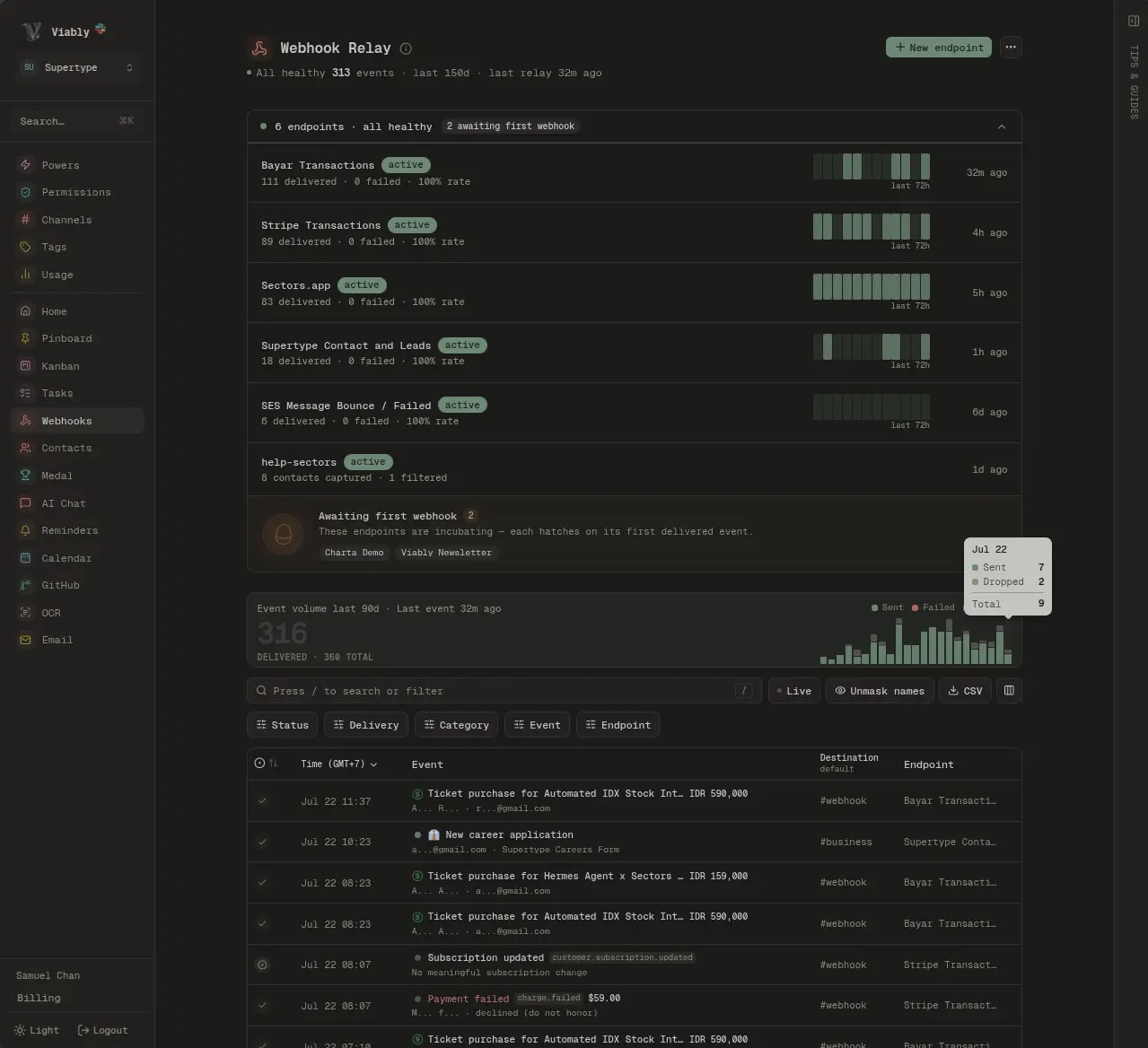
If you sign up to Viably as a Slack workspace, Viably spawns @Via as a coworker in your workspace, so you can receive all the key events, transaction notifications, crash reports, key CRM events and other important signals directly in Slack. For key signals, you might want it delivered instantly, and for less-important signals, you can choose from multiple batching strategies to receive them in a digest form on a cadence that works for you. Viably relays the right signals to the right people at the right time, and periodically produce an aggregated report so you are reacting to external events without drowning in them.
Ownership begins with participation
Viably works best when your team actively engage and participate in the process of shipping meaningful work that moves the needle. To do this, they need to be able to peek into the system and see what is happening to the business, around their customers, and associate each of their actions with the outcomes they produce. Too often, businesses regress into a state of “management by exception” where the team is only aware of the business when something goes wrong, and they are not able to see the impact of their work on the business. Viably flips the script by adding a layer of observability and transparency into a team serious about matching work with outcomes.
Viably give workspace owners user roles and permissions to control who can see what, and how much of the business they can see. For example, a workspace owner might want to give their team access to the CRM and the Inbox, but not the Usage panel or the Month-in-review. A typical Viably workspace consists of Admins, Managers, regular Members, Limited Members and Guests, where the two latter are typically time-bound roles for contractors, interns, or external collaborators. Each role has a different level of access to the workspace, Viably communicates the level of access clearly to each users.
Viably can also play the role of employee performance and appraisal because it integrates a concept of “medals” and “bounty” to reward team members for their contributions. The month-in-review celebrates the team's top contributors across multiple dimensions, and the in-slack assistant @Via can also be used to reward team members for their contributions and recognize their achievements. @Via produces a leaderboard through the /medal command and a report card of any team member through the /medal @username command.
Viably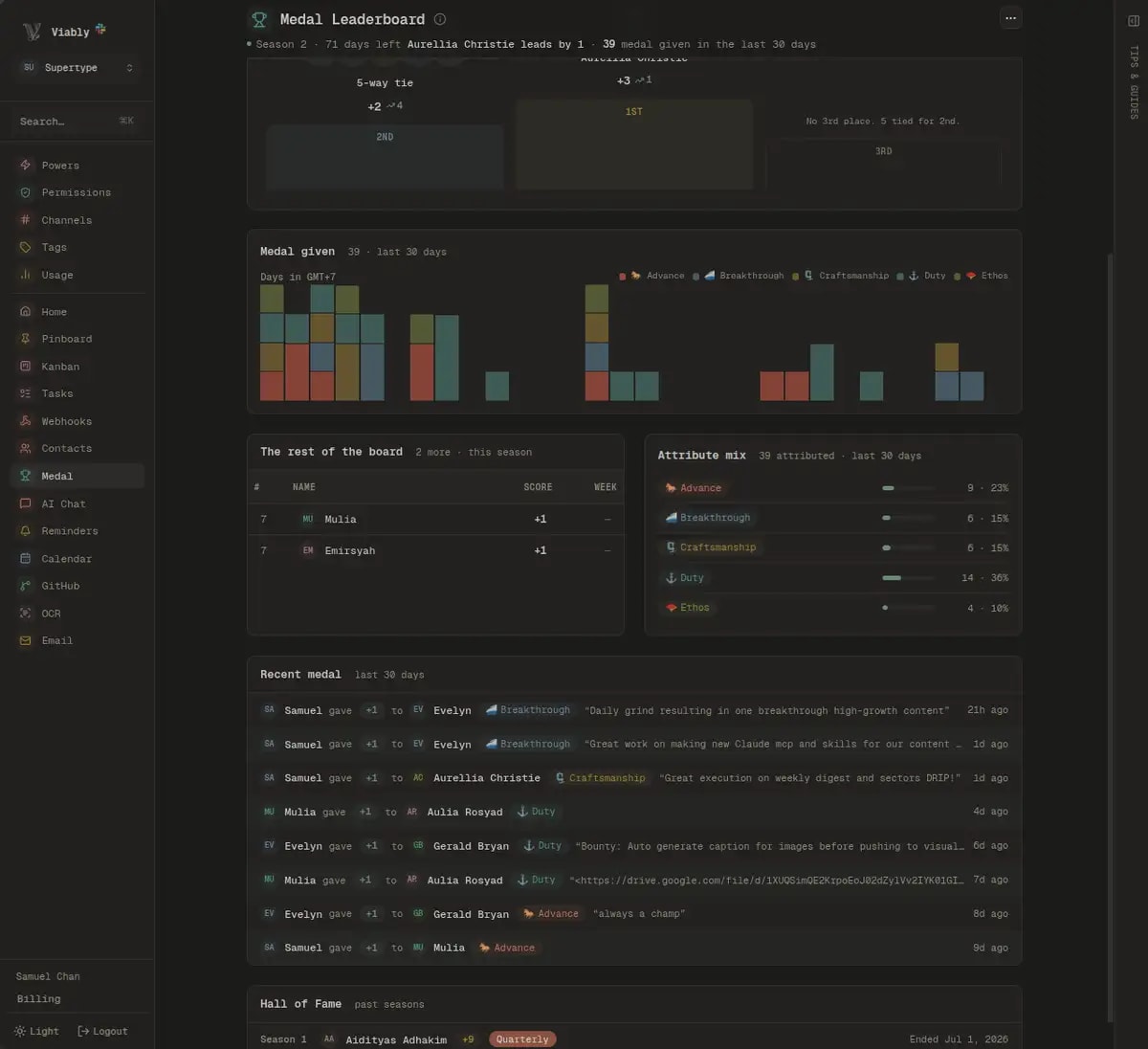
Automation by default
The final tenet of the Viably philosophy is that automation should be the default, and that your team should not have to manage work when the alternative is to eliminate it. Viably accomplishes work elimination by gluing together processes spanning CRM, email, Slack, Stripe, Google Search Console, its native task management, and other integrations into an observability-first system that keep your system of records up to date and move tasks off the backlog.
Don't manage work when the alternative is to eliminate it.
When you add @Via, our in-Slack assistant to your workspace, it automatically adds more than 10+ automations to your workspace. To try one of them, turn on the OCR power in your Viably workspace, upload a photo containing up to 20 business cards (in any orientation), then add a 📸 emoji to the photo, and Viably automatically extracts all the contact information into a CSV that it paste into your message. One tap, and Viably automatically import and merge these contacts into your CRM and start its enrichment loop.
Found a bug? add the 🐛 emoji to any Slack post and Viably collects any screenshots in the threads and intelligently files an Issue on Viably along with the relevant context, issue reporter, screenshots, and starts tracking the issue on your team kanban.
Viably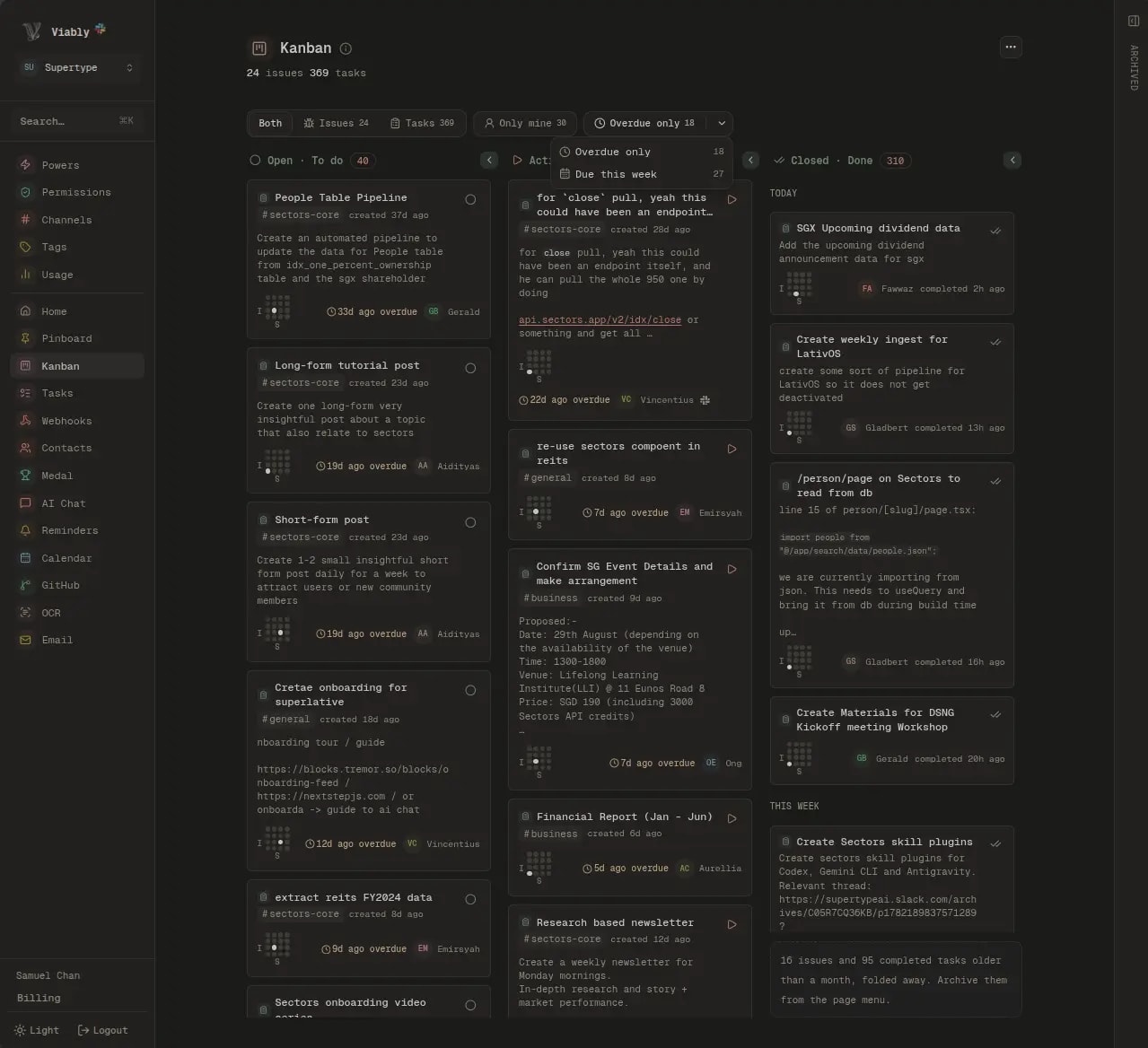
Every little decision in Viably is guided by the automation-by-default principle, because for a team busy punching above its weightclass, every minute of overhead matters and every bit of friction compounds into an unmanageable backlog. Viably imposes an automation-first philosophy so the capture-to-action loop is as short as viably possible and not any more.
If these five principles describe the way your team already wants to work, the companion piece to this one is who uses Viably, where I write about the teams these principles were drawn from and what arrives in a workspace on day one.